Ph. Dialogue「博士人材セミナー」は、Ph. Discover連携企業からゲストを迎え「博士課程修了者が企業でどのように活躍しているのか」「企業は博士人材に何を求めているのか」について話していただき、後半はゲストと学生が対話を通して交流する企画です。7回目は高橋陸さん(NTT物性科学基礎研究所)をお迎えしました。
NTT Basic Research Laboratories:
One of the laboratories of Nippon Telegraph and Telephone Corporation (NTT). His mission is not only to contribute to the NTT business, but also to contribute academically, such as the acquisition of universal knowledge.
Joined NTT after expanding job hunting options and making efforts to sell myself

Nice to meet you, my name is Riku Takahashi. Although I received a degree in life science, my research area was materials science, which is close to engineering. The interesting thing about hydrogels is that their functions can be expanded by combining them with different materials. I was fascinated by its charm, and since I was in graduate school, I wanted to continue researching new materials based on hydrogels.
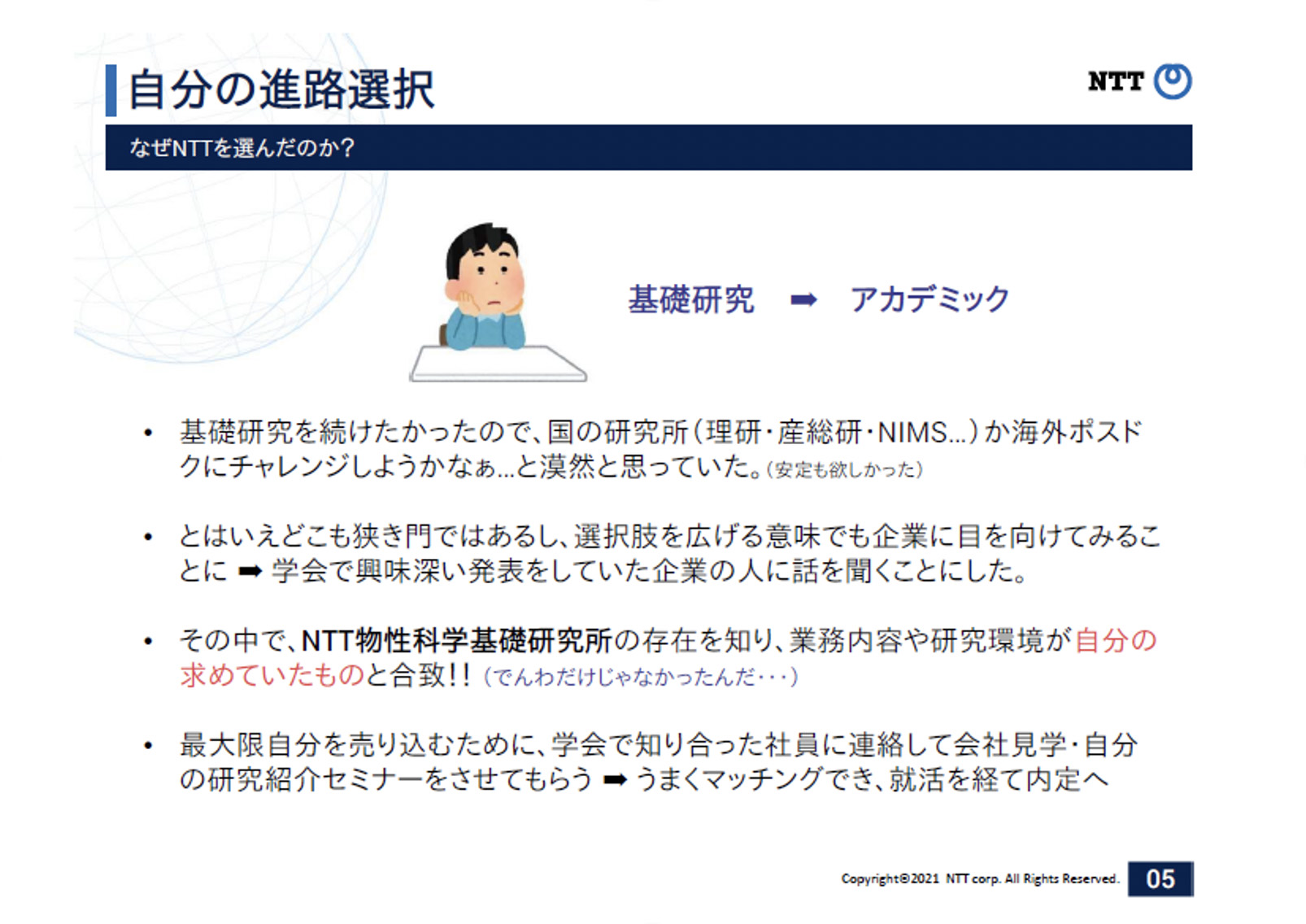
In order to continue basic research, I was thinking of going to academia. On the other hand, it is also true that I was worried about whether I would be able to stabilize my life. First, I decided to turn my attention to companies in order to broaden my options, so I decided to ask around companies that had made presentations at the Society of Polymer Science, to which I belonged. During that time, I happened to come across NTT's Basic Research Laboratories, and when I gathered various information about their work and research environment, I became interested in it because it matched my career aspirations. After that, I contacted an employee I met at an academic conference, who let me tour the company and introduce my research.

NTT Basic Research Laboratories, whose mission is to contribute academically
I'm sure everyone has heard of the company NTT, but NTT East, NTT West, and mobile phone docomo are operating companies. It will become a holding company called NTT. NTT has research laboratories that conduct research that forms the basis of the entire group, and one of them is where I belong.
NTT's goal is to realize a smart world through technological innovation. Finding and cultivating the seeds of research that can contribute to this is a major mission of the Institute.
NTT's laboratories are divided into four major research institutes, and each research institute is further subdivided into three or four research laboratories. Among them, I belong to NTT Basic Research Laboratories of NTT Advanced Technology R&D Laboratories. NTT Basic Research Laboratories' mission is not only to contribute to NTT's business, but also to contribute academically, such as the acquisition of universal knowledge.
The research in the Molecular Biofunction Research Group, where I work, is divided into basic research and applied research. In basic research, we are working on the creation of devices that read information in vivo by combining bio-soft materials such as gels and polymer thin films with processing, measurement, and control technology. For applied research, our current goal is to expand the use of hitoe® *, which was jointly developed with Toray Industries, Inc. hitoe® is a T-shirt-shaped bioelectrode that is attracting attention as a wearable device that can measure electrical signals such as electrocardiogram and myoelectricity just by wearing it.
* What is hitoe®: A functional material that collects biosignals, which are weak electrical signals that we unconsciously emit from our bodies, in a state close to unconsciousness. By accumulating and analyzing biosignals, it is possible to utilize not only efficient sports training, but also information that is not usually conscious of, such as changes in physical condition and degree of tension, in a visible form. Details https://www.hitoe.toray/
Working life as a member of academia, working hard on research
研究紹介の次に、働き方について紹介します。ミッションとして「中長期的NTT事業への貢献のみならず、普遍的知見の獲得などの学術的貢献」と話しましたが、基礎研究の部署では、「研究をして論文を書く」ことが重要です。ですので、社会人生活は思っていた以上に博士課程での研究生活のままでした。入った1年目から自分のやりたいことを見つけて研究提案できますし、重要性や意義がきちんと説明できればかなりの自由度で研究を展開していくことが可能です。会社なので、結果が出始めたら特許出願することになりますが、年2~3回の学会発表や国際会議での発表など、テーマ立ち上げから論文執筆まで、アカデミアと同様に仕事を進められます。また、こうして培われた革新的な基礎技術を用いて、中長期的NTT事業へ貢献していく取り組み(応用研究など)も大変重要なミッションです。
Required management skills
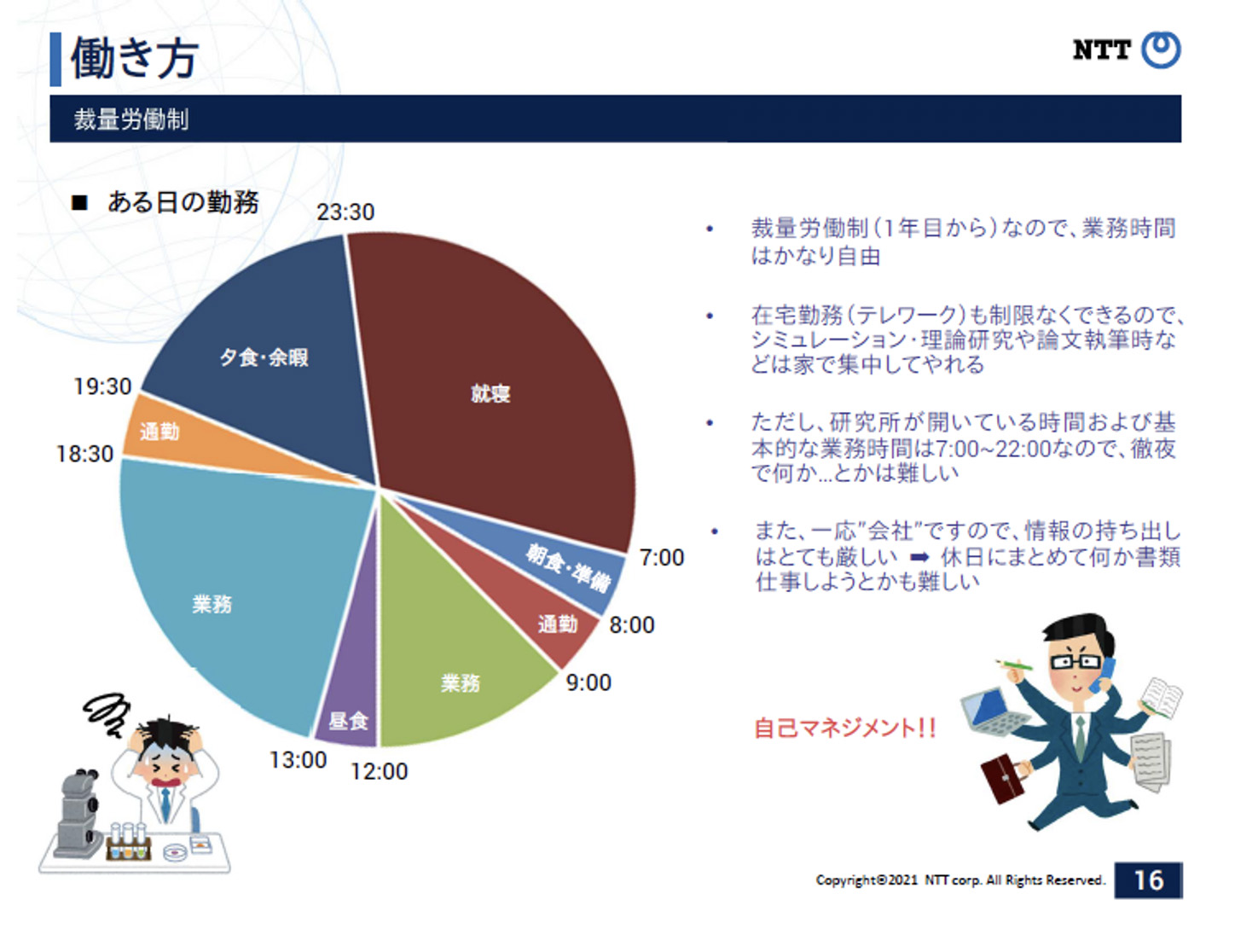
Working hours can be adjusted freely because of the discretionary labor system. There are no restrictions on telecommuting, and simulations, theoretical research, and writing papers can be done at home without going to the office. However, since it is a company, it is important to work while managing your own time well according to your working hours.

Also, the major difference in the research environment compared to academia may be that the research budget is stable. We receive a portion of the operating company's sales as research expenses, so we have a very favorable research environment. It is also possible for individuals to obtain research funds such as external funding such as Kakenhi. Thanks to this, we are well-equipped with equipment and devices, and we don't have to worry about running out of consumables.
Another difference is how to secure personnel. In academia, we assign themes to students and graduate students assigned to laboratories, but at NTT, when we need the cooperation of others, we take action ourselves. For example, it is necessary to have the university as an intern trainee, or to outsource the work.
In summary, you can do research very freely in a well-equipped and stable research environment, but in order to mass produce high-quality papers, it is necessary to cooperate with external parties and conduct research while managing it. I think that is the research activity at NTT.
sharp or broad expertise
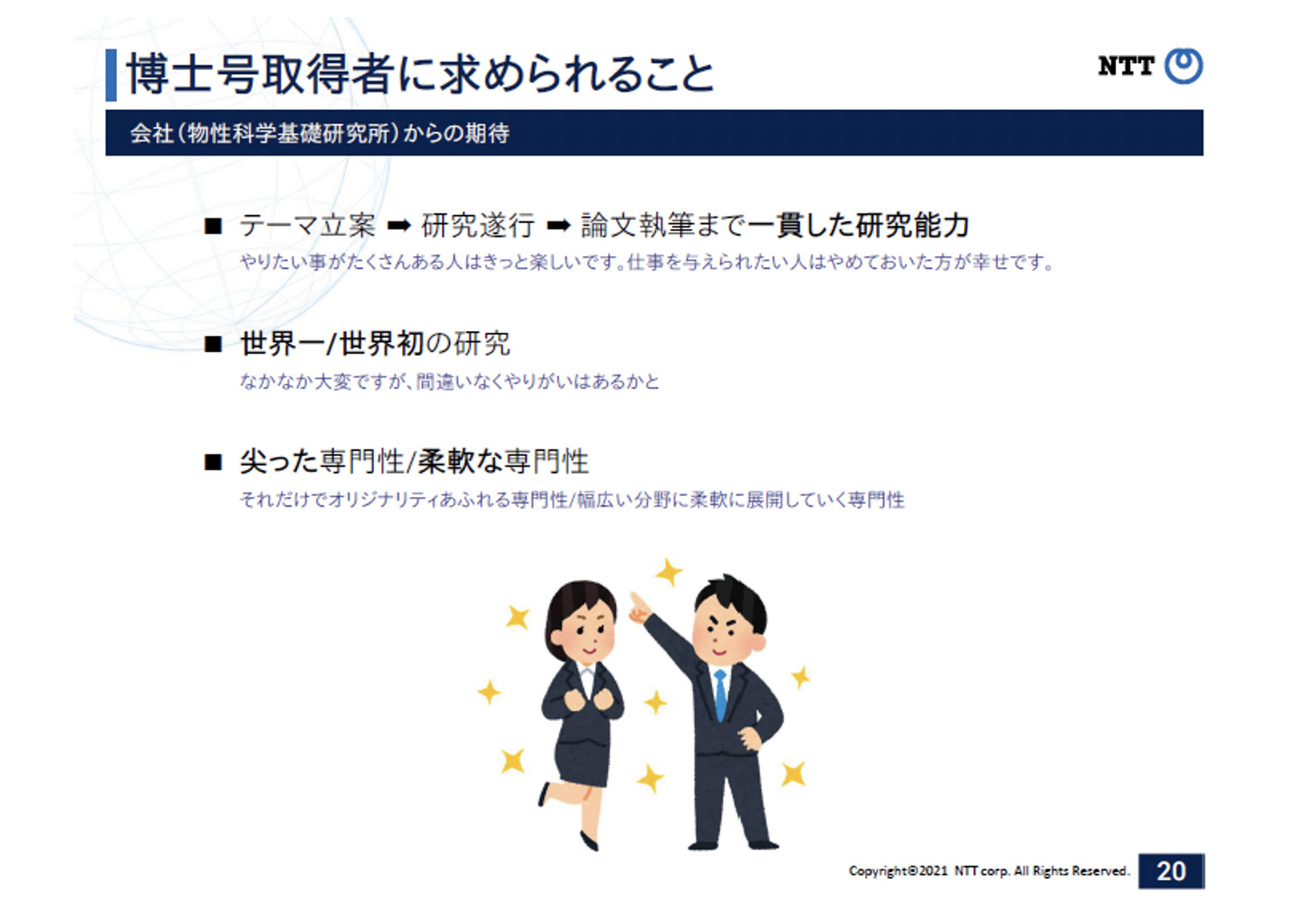
Finally, I think that what companies expect from doctoral students is the ability to conduct consistent research, from the establishment of a theme to the writing of a thesis. On top of that, it is necessary to be a researcher with originality and sharp expertise, or expertise that can be flexibly and widely applied. It's tough to be asked to produce the world's best and world's first research results, but it's rewarding.
弊社には、アイディアから事業の芽をつくる「ゼロからイチ」という部門と、「一から百」にする「事業の拡大と効率化」をする部門があります。この一連の研究開発のどこかで、知のプロフェッショナルとして活躍してほしい、それが博士人材に求めていることだと感じています。
コミュニケーションタイム
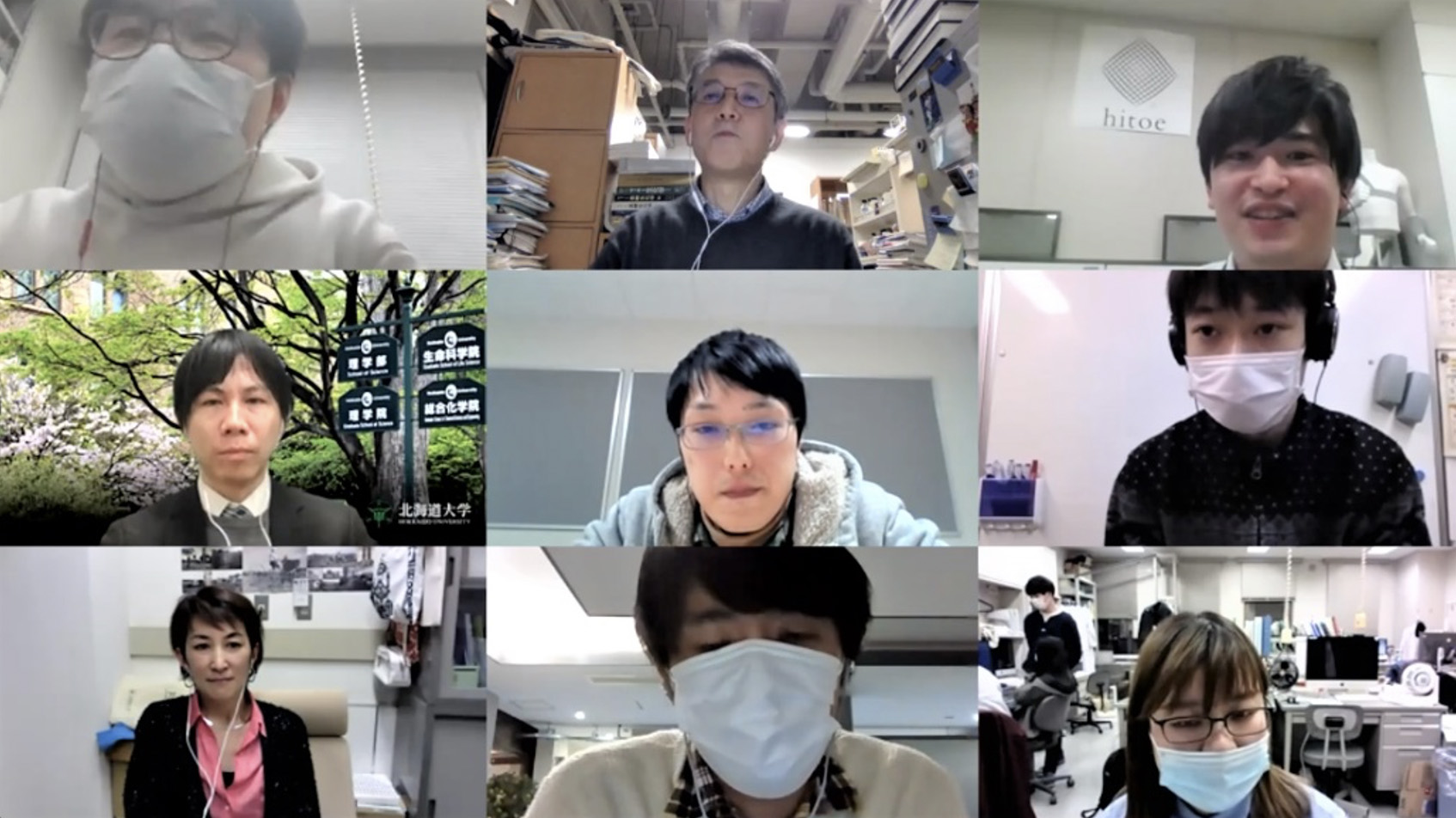
From the viewpoint of selection, whether what you want to do matches the nature of the company
Q:Does the field of study matter when looking for a job?
Takahashi: Since you are a doctor, I think you will be able to see your field of study at first. During the selection process, you will have the opportunity to make a presentation about what you want to do, and I think it will be important to match the direction of the company well.
Research theme is free to explore what you want to do
Q:How are the themes decided?
Takahashi: In your first year, you will follow a senior student and start by writing a thesis. After that, most people do what they want. At the end of the second year, I will have the opportunity to talk about how I want to proceed with my research over the next five to ten years, so I will think about the theme and direction I want to work on. If I can't find it on my own, I sometimes decide on a theme while talking to my superiors and seniors, but I have a strong impression that everyone is doing what they want to do in the end.
Q:Are the themes often related to the themes you were doing in your doctoral program?
Takahashi: It depends on the person. Some people stick to their specialty all the time, while others change their themes completely.
Most of them have PhDs, and the environment is not much different from academia
Q:What is the percentage of those who have doctoral degrees?
Takahashi: At Basic Research Laboratories, most people seem to have PhDs. I hear that some people who have entered the company after completing their master's degree obtain doctoral degrees as working adults after joining the company.
Q:Are there exchanges and discussions with other fields within the Institute for Solid State Physics in the same way as in academia?
Takahashi: In that regard, it's the same as in academia labs, from small subgroup meetings to full-scale meetings. In addition, when I practice giving presentations at academic conferences, I can freely listen to other people's presentations, so I think there are many opportunities for interaction.
Q:I have the impression that the environment is very similar to academia, but is there anything that is different from academia?
Takahashi: Collaborating within the company can be done in the same way as at a university, but if you try to conduct joint research outside the company, you will need to do clerical work such as signing contracts, so it may be a little more difficult. . In addition, the ability to smoothly transition from the research to the development phase is considered to be one of the strengths of a corporate research institute.
研究は成果がすぐに出ずとも長期的に。成果報酬もモチベーションになる。
Q:I think that companies are expected to produce results, but what do you do when results do not come easily?
Takahashi: The company recommends challenging themes. However, the higher ups understand that the more challenging the research is, the more difficult it is to produce results, and they look at the research from a long-term perspective. I have the impression that everyone is working with a sense of purpose, trying to grab a chance someday.
Q:Will I ever be ordered to change departments because I am not producing results?
Takahashi: I have heard that after consulting with people in the group, they changed the theme a little because it was difficult to produce results, or changed departments at their own request. I've never heard of it.
Q:Do you have a system that allows you to receive money for your research results?
Takahashi: You will be evaluated based on a combination of quantitative results, such as the number of papers published, and qualitative results, such as actions and contributions to the team.
Q:Does that motivate you?
Takahashi: It will be. I think it's easy to see my short-term motivation because my work and actions are properly evaluated from a quantitative and qualitative perspective.
Among the diverse career paths, many return to academia
Q:What kind of career paths are there? Will some go back to academia?
Takahashi: There are various options available, such as a senior special researcher system that allows you to continue your research in-house, a transfer to the development department along with your research theme, or a transfer to the human resource development department. Also, even if you want to continue basic research, you have the option of moving to academia outside the company, and it seems that some people are making such a choice.
Q:Change of interests is the reason for returning to academia? Or do you want to continue your research?
Takahashi: I think there are people who want to do something closer to the university because their interests have changed. I think there are other reasons why students return to academia because they want to continue their research while being involved in educating students.
Launch: March 10, 2021
Organizer: Ph. Discover
Co-organizer: Hokkaido UniversityFaculty of Science/Hokkaido University Center for Mathematics and Data Science (Data-related Human Resource Development Program) / Hokkaido University Doctoral Program for Materials Science Leading Program