
Ph. Dialogue「博士人材セミナー」は、Ph. Discover連携企業からゲストを迎え「博士課程修了者が企業でどのように活躍しているのか」「企業は博士人材に何を求めているのか」について話していただき、後半はゲストと学生が対話を通して交流する企画です。6回目は株式会社ブリヂストンから大月正珠さん、幸村憲明さん、角田克彦さん、森下善広さんの4人をお迎えしました。(大月さんと幸村さんは博士を取得後入社。角田さんは入社後海外留学してイギリスで博士号を取得、森下さんは入社後海外留学して国内で博士号を取得しました。)
Bridgestone Corporation:
Founded in 1931. A global manufacturer of tires, bicycles, and sporting goods. In recent years, we have placed sustainability at the core of our management, and are working on solution businesses that leverage the strengths of our tire and rubber businesses.
Hello everyone, this is Yukimura from Bridgestone. In 2007, I obtained a doctorate in organic chemistry and joined Bridgestone. For 11 years after joining the company, I was involved in the development of raw materials for tires, making use of the organic chemistry expertise I learned at university. It was when I became a manager in 2017 that I felt the power of a doctorate was important. I was required to formulate an R&D strategy from scratch, think about how to achieve it, and put it into action. No goal was given and no decision was made as to what to do. This overlapped with my doctoral course experience of “finding and setting a problem for myself”, and I thought that the power of the doctor would be greatly utilized in my work.
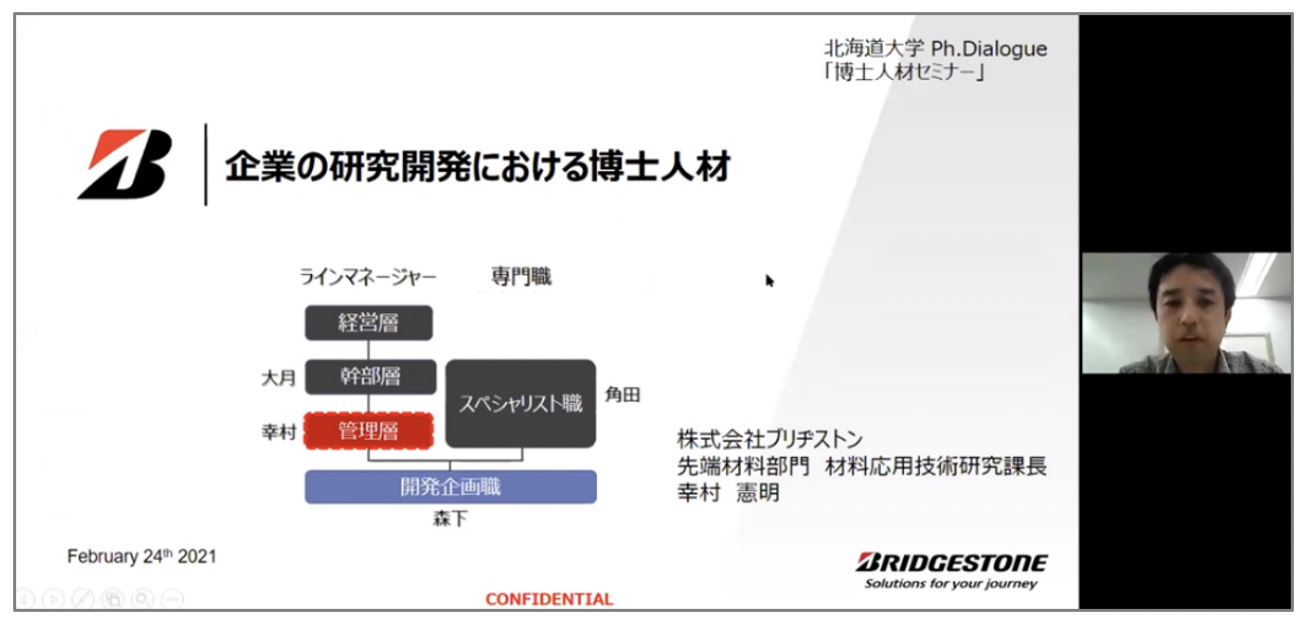
Two skills required for a doctorate: the ability to propose problems and the ability to understand
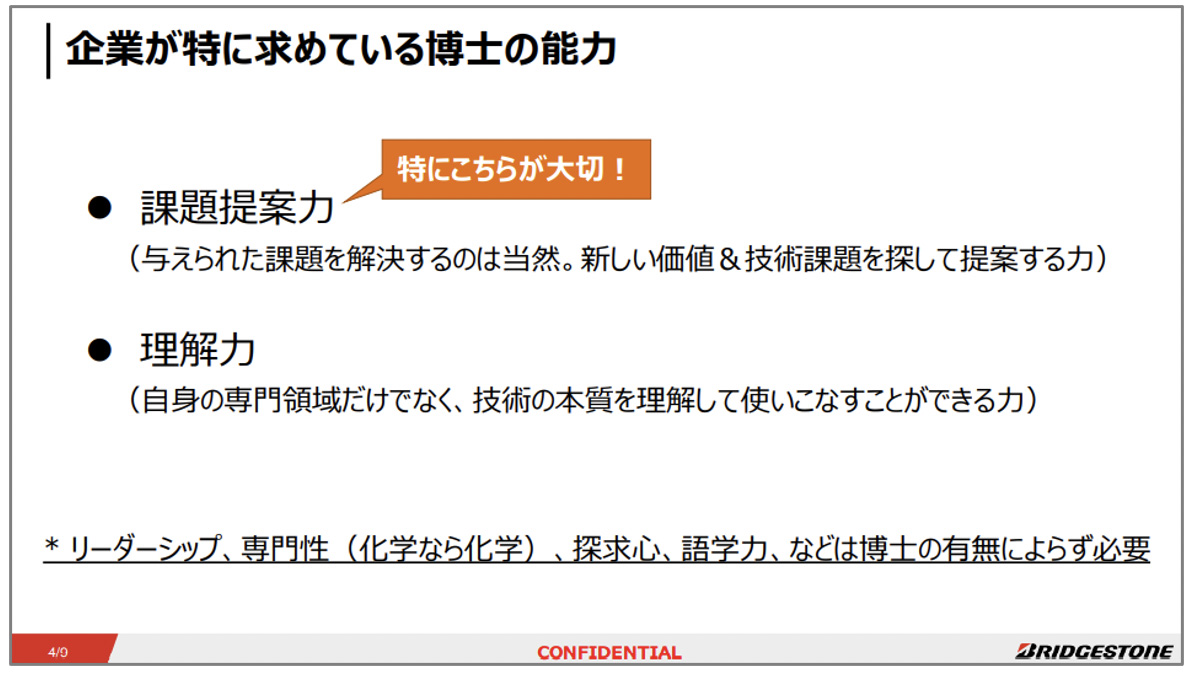
Today, people's lives are saturated with things, and the need for technological development and the hurdles for goals are rising. In that case, it is not enough just to complete the task given, it becomes necessary to seek out new value and technical challenges and take the lead. I believe that this kind of problem-solving ability is what is required of doctoral human resources.
For example, back in the late 1980s, Bridgestone studless tires were by far the best. However, other companies are catching up with the level, and the price is going to be cheaper. So, next time, we can't say to the customer, "We made a tire that has twice the performance and lasts twice as long, so please buy it at twice the price." Even if I run twice as long, I will change the car in the meantime. We need to focus on what the world needs and develop technology that can contribute to society from a sustainable perspective.
In order to hone your ability to propose problems, you should set your own themes even in the doctoral course. There is no point in setting a simple theme.
Another is comprehension. People outside my area of expertise, for example, tires, are made by integrating technologies such as chemistry, computational simulation, structure and surface pattern design, and metal processing that goes inside the tire. If team members with different fields of expertise do not understand each other, synergistic effects cannot be created and good products cannot be created.
In order to improve understanding, it is natural to understand the theme of the members of the laboratory, but I think the first step is to be able to understand each other with people in similar fields in other laboratories. The next step is to be able to understand the themes of people in fields different from your own, and finally, to be able to understand the themes of people in different fields and use your own strengths to give advice. The last step is especially important at work, so please try it.
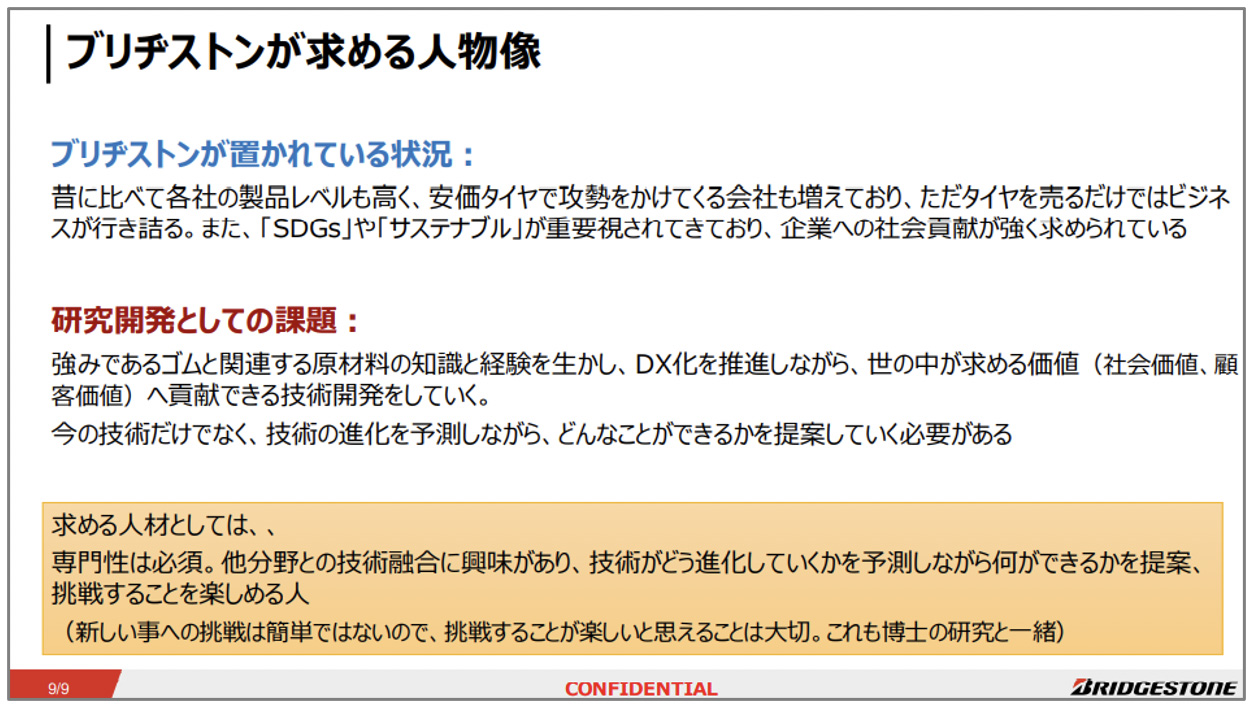
Contribute to the value sought by society and realize sustainability
Our company is looking for people who can contribute to the value society seeks, and who can use their strengths in technology to achieve the SDGs and sustainability. We need people who broaden their horizons, anticipate future technological evolution, propose what can be done, and take on challenges. Expertise is essential, but Bridgestone is looking for people who can make proposals and take on challenges, and who enjoy doing so.
20 years experience in frontline development and 10 years experience in basic research
This is Tsunoda from Bridgestone. On behalf of Yukimura, I would like to talk about doctoral human resources from a long-term perspective. I joined Bridgestone in 1991 and was engaged in material development for non-tire products such as caterpillars, conveyor belts, and hoses. I studied abroad for a while to get my doctorate, but for the 20 years since I joined the company, I basically worked on the front line of development, interacting directly with customers.
Around 2010, 20 years after joining the company, I was transferred to the current Advanced Materials Division, where my work was mainly related to basic research. There, I am involved in research on national projects such as ImPACT, an innovative research and development promotion program promoted by the Cabinet Office, Future Society Creation Program, MOONSHOT research, and CREST research. I have also been a visiting professor at Hokkaido University since April 2018, and based on my experience in moving basic research closer to academia, I would like to talk about what a company's doctoral talent should be like.
The aim of corporate research and development is social implementation
「革新的研究開発推進プログラムImPACT」という国家プロジェクトに参画した事例を紹介しましょう。プロジェクトの目標はタフポリマー、強い高分子材料を作ることで、私たちは多様な研究開発を同時並行で進めることにしました。例えば粘弾性の研究であれば、高分子物理の博士を、放射光を使った実験や解析には、分析の散乱実験が専門の博士をあたらせました。さらに、製品化を想定したモノとしての具現化には高分子合成の博士を、理論物理や計算機シミュレーションには計算科学の専門知識がある人をといったように、企業側からも多くの博士人材を動員し研究しました。このように、連携するアカデミアの先生たちと対等な研究パートナーとなって、新技術を作り、新しい学理を作ったのです。そして、最終的に社内で社会実装のシナリオを描きながら製品化を進めました。
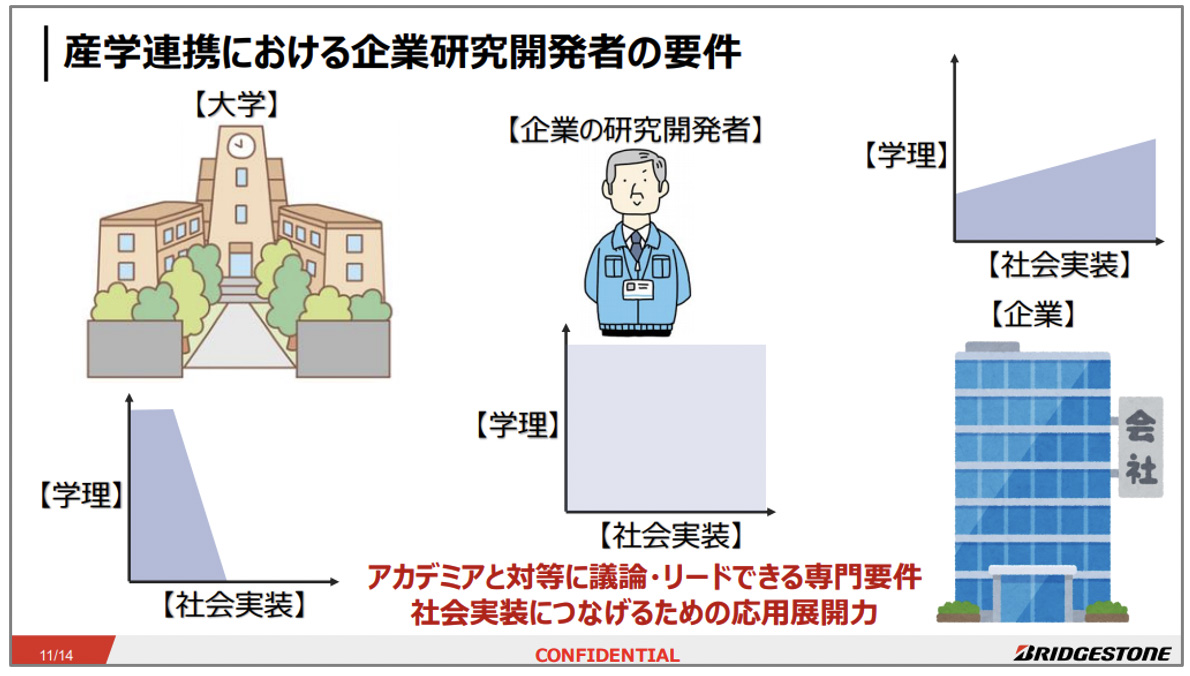
Since we are a company, our goal is not pure basic research, that is, the establishment of scientific principles. Companies are required to conduct research with a view to contributing to their business activities and implement the results in society.
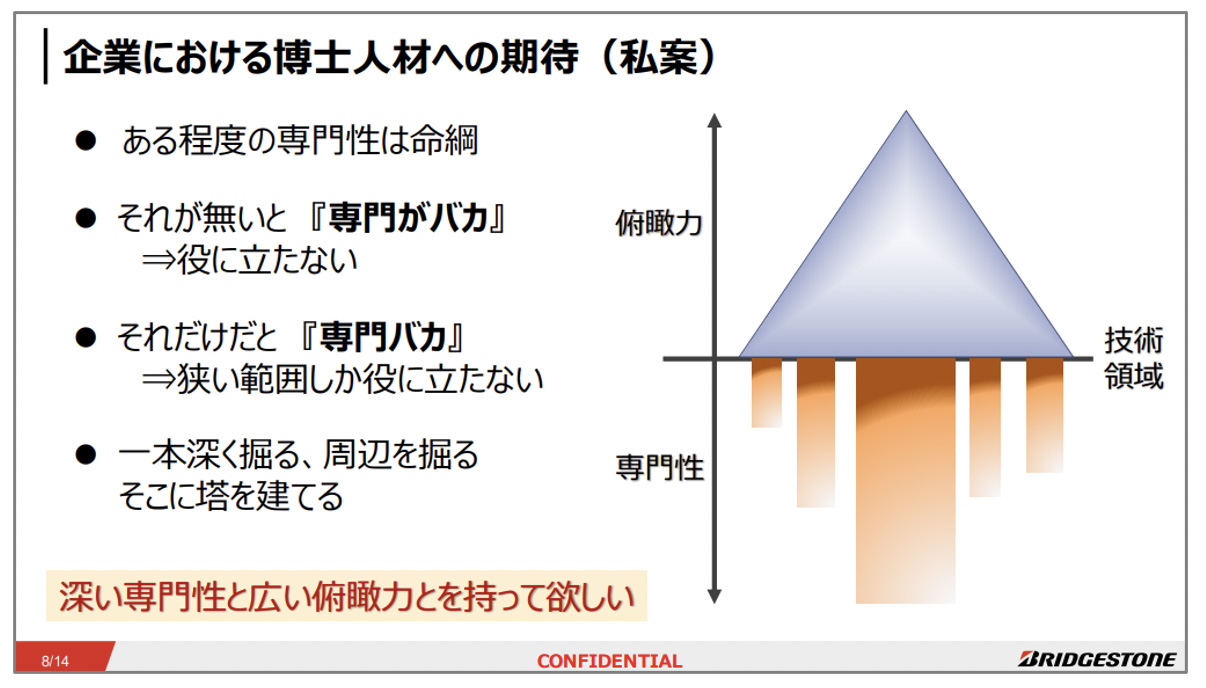
Looking at the two axes of academic theory and social implementation, universities are doing research and development that emphasizes academic theory, while companies are mainly doing social implementation. Therefore, researchers at companies that collaborate with academia need to have deep expertise to hold discussions on an equal footing with academia and lead the technology, as well as broad perspectives to write scenarios aimed at social implementation. In order to have both of these abilities, one must first dig deep into one's specialty and acquire various knowledge around it, even if it is shallow. And if you build your own field on top of that, I think you'll acquire deep expertise and the ability to see things from a broad perspective.
I hope that you will be aware of what I have said today and become a doctor who can contribute to corporate activities while you are still a student.
コミュニケーションタイム
Communication skills are important in addition to expertise and perspective
Q:When hiring, which one would you prefer, someone with excellent expertise, or someone with a certain degree of expertise and a relatively good understanding of related fields?
Otsuki: I think both patterns have the potential to be active in companies. However, communication skills are necessary as a plus alpha. At a company, communication skills inside and outside the company are extremely important, such as how to fuse with fields outside your specialty and how to connect business with academia.
Tsunoda: When I interview for a job, I ask not only about the person's research, but also about what the student next door is doing, the equipment of the laboratory as a whole, the research being done in the department, and the synergy between them. doing. I take it for granted that I can talk about myself, and I've been shown how I look at my surroundings from a broad perspective during my time at university.
Q:At Bridgestone, are there any differences in hiring conditions for master's and doctoral graduates?
Otsuki: Ph.D. recruitment is outside the scope of employment agreements. There is no big difference in terms of hiring conditions and interview content.
Creating scenarios through communication
Q:What exactly is the ability to write a scenario up to social implementation?
Tsunoda: You don't have to write the scenario by yourself. When you have an interesting topic in your immediate area and want to write a path to commercialization from that point, it is important to be able to create a scenario and an overall picture while communicating with people who are knowledgeable about that topic.
Morishita: When thinking about a commercialization scenario, I think there are two perspectives: the business perspective of whether it will be a business, and the technical perspective of whether it is feasible as a technology. There is a specialist in the company about the business point of view, and we can communicate. I believe that one of the strengths of doctoral personnel is that they can think of scenarios and make proposals from both business and technical perspectives.
More efficient development with the power of computational chemistry
Q:I specialize in computational chemistry, and you mentioned molecular dynamics calculations in your talk.
Otsuki: In the past, we used our hands to experiment and create new products through repeated trial and error, but it was a very wasteful process. Now, it is possible to simulate various hierarchical structures and physical properties of the material rubber, which has improved efficiency. In this way, we can reduce the materials and time used for experiments, and computational chemistry is extremely important for the sustainable development of new products.
Q:Can you give me a specific example where computational chemistry was useful?
Yukimura: The raw materials of rubber are polymers, chemicals, carbon black, etc. If we can predict what kind of reaction will occur at what temperature, then we can do new thought experiments. Even if we fail, if we can find the reason by calculation, we can think about how to change the molecular structure and how to set the binding energy, so it is very useful as a tool to accelerate development.
Q:How do you keep pace with the experimenter when there is a discrepancy between the experiment and the simulation?
Otsuki: After deriving a number of candidate materials using computational chemistry, we are verifying how well the intended results will be achieved in actual experiments through communication between the computational chemist and the experimenter. Even within computational chemistry, it feels like we are repeatedly debating which theory to choose. Also, there are areas where computational chemistry itself is very useful, and there are areas where it is completely useless.
It is possible to make use of the universal power of mathematics
Q:I think it is difficult to directly connect pure mathematics to social and corporate contributions. Can mathematics majors contribute at Bridgestone?
Otsuki: First of all, it is not limited to mathematics majors, such as people with chemistry backgrounds working on materials, and people with mechanical backgrounds working on equipment. However, even if we are not connected to one another, we can definitely make use of the strengths we have cultivated at university and our strengths in mathematics. For example, I am currently working with Toyota Motor Corporation to build a car that will be taken into space, and people in the field of mathematics are studying formulas to find out what happens when tires are taken into space.
Tsunoda: For example, using a model to infer the internal structure from the stress data when a rubber with a complex hierarchical structure is pulled and deformed is basically a matter of mathematics. Therefore, there are many situations where mathematics is useful even in the field of materials development.
Morishita: The power of mathematics to properly understand the essence of science, formulate it, and explain natural phenomena is universal, and I think it can be used widely. Based on your own strengths and expertise, wouldn't it be better to think positively about what kind of proposals you can make and what kind of value you can create?
Launch: February 24, 2021
Organizer: Ph. Discover
Co-organizer: Hokkaido UniversityFaculty of Science/Hokkaido University Center for Mathematics and Data Science (Data-related Human Resource Development Program) / Hokkaido University Doctoral Program for Materials Science Leading Program